
How to Handle an Unhappy Nail Client
Quick answer: Listen without defending, then sort the complaint into fixable or unreasonable. For anything fixable, offer a free repair inside a stated window, usually 48 to 72 hours, before any talk of refunds. Keep the conversation in one channel, put the policy in writing, and photograph every finished set before the client leaves.
The message usually lands on your day off. "Hi hun, two nails have chipped already and I'm really not happy." Your stomach drops, you reread it four times, and you draft three replies you don't send.
Every nail tech gets this message eventually. The techs who come out of it with the client still on the books tend to have one thing in common: they decided what happens next before it happened.
Is the complaint fixable or unreasonable?
Before you reply to anything, sort the complaint. Almost every one falls into one of two piles, and the piles get different answers.
Fixable complaints are about the work. A chip or lift within a few days, a shape that isn't what they asked for, polish that bubbled, a smile line that wandered. These are covered by your repair policy, whether or not you have written one down yet. The set failed early or missed the brief, and the professional answer is to put it right.
Unreasonable complaints are about everything else. They picked the colour and now dislike it a week later. They opened a can with their nails on day two. They want a refund but refuse to come in so you can see the damage. They were happy in the chair, posted the set, and turned unhappy when a deposit for the next appointment came up.
The reason this sorting matters: fixable complaints deserve speed and warmth, and unreasonable ones deserve calm boundaries. If you give every complaint the same response, you either refund people who broke their own nails or argue with people whose gel genuinely failed.
What do you say in the chair?
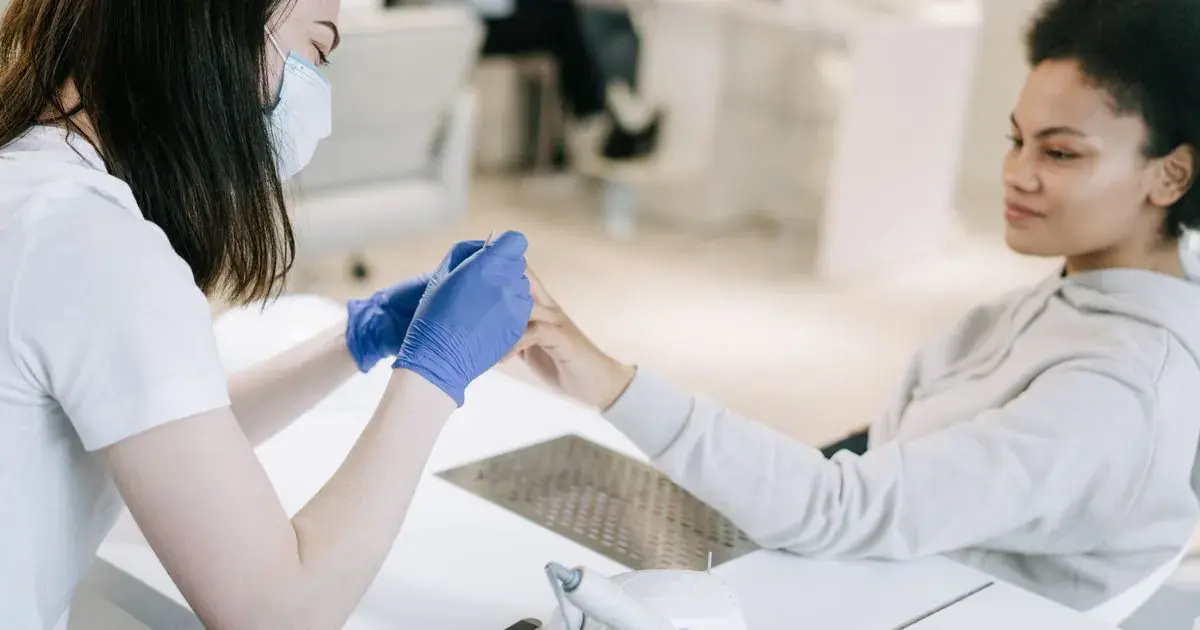
Sometimes the unhappiness surfaces before they leave. They go quiet, tilt the hand, say "hmm, I thought the almond would be slimmer."
This is the cheapest complaint you will ever get, because the fix is still in the room. Ask one question: "What would you like me to change?" Then change it if you can. Ten extra minutes of filing costs you almost nothing against what a silent, disappointed client costs you later.
Don't over-apologise and don't explain your technique at length. A client who says the shape looks wrong doesn't want a lecture on C-curves, they want the shape they asked for. Fix first, educate later, and only if they ask.
If what they want isn't possible (they approved short and now want long), say so plainly and offer the honest options: a new set at the normal price, or a tweak inside the current one.
How do you handle a complaint sent by DM?
Most complaints arrive by message, often days later, often with a photo. A few rules keep this from going sideways.
Reply the same day, even if only to hold. "Thanks for letting me know, I'm sorry it's chipped. Can you send me a photo of both hands? I'll get you booked in to sort it." You haven't admitted fault or promised a refund. You have shown up, which is most of what an upset person needs in the first hour.
Ask for photos before you decide anything. A picture tells you whether you are looking at product failure at the cuticle or a break halfway down the free edge from an impact. That is diagnosis, the same thing you would do with the hand in front of you, and clients rarely object to it.
Keep it in one channel, too. If it starts in Instagram DMs, keep it there. A complaint that hops from DM to text to a comment under your latest post becomes impossible to follow and much easier to escalate.
And write like you expect it to be screenshotted, because it might be. Keep it short and warm, with no sarcasm and none of that "as per my policy" frost.
Should you fix it or refund it?
Fix first, refund rarely. A free repair inside a stated window is the strongest policy in the industry for a reason: it puts the client back in your chair, it shows confidence in your work, and it costs you time instead of cash. A refund ends the relationship and quietly confirms the work was bad, even when it wasn't.
A workable policy looks like this: free repairs on chips or lifting reported within 48 to 72 hours, repairs after that at a small charge, and the client needs to come in so you can see the nails. Some techs run seven days for gel; pick the window you can stand behind and apply it to everyone.
Refunds still have a place. If the work genuinely failed across the whole set, if you cannot get them back in within a reasonable time, or if the relationship is beyond saving and £40 buys the end of it, refund and move on. A couple of refunds a year will not hurt a nail business. Weekly arguments will.
Here is how the common responses actually compare:
| Response | What the client hears | What it costs you | What it does to your name |
|---|---|---|---|
| Ignore it | "You don't matter now I've paid" | Nothing today, the client forever | Bad review, told to friends |
| Argue the point | "You're lying about my work" | Hours of stress | Screenshots travel |
| Refund instantly | "The work was as bad as you thought" | Full price, plus the habit it teaches | Attracts refund hunters |
| Fix-first policy | "I stand behind my sets" | 20 to 40 minutes | Often ends in a better review |
What if they leave a bad review?
Sometimes the first you hear of the problem is a one-star review. Breathe, then reply once, publicly, within a day or two.
The reply is not really for the reviewer. According to BrightLocal's Local Consumer Review Survey, 80% of consumers say they are likely to use a business that responds to all of its reviews, and 42% are unlikely to use one that never replies. The next potential client reading that review is your real audience.
So the public reply stays short and graceful: sorry to hear it, this isn't the experience you aim for, here is the repair policy, and an invitation to sort it directly. Never dispute details in public, even when you are right. "She actually shut a car door on them" wins the argument and loses every reader.
Then move the conversation private and handle it like any other complaint. If it resolves well, some clients will update the review on their own; a gentle ask afterwards is fine. There is more on managing that side of things in how to get nail client reviews.
How do photos protect you?
The strongest card in any complaint conversation is a clear photo of the finished set, taken before the client left.
When someone says the shape was uneven or a nail was already chipped, a dated photo answers it without a single defensive word: "Here's the set when you left on Tuesday." It also settles the honest cases fast, because if the photo shows a flooded cuticle, you can see it too, and the repair conversation gets easier on both sides.
You are probably shooting most sets already for Instagram. The change is making it every set, both hands, even the plain infill you would never post. The same habit powers your before and after photos, so it is one photo doing two jobs.
Complaints about money have their own paper trail. A written deposit and cancellation policy prevents half of these arguments from ever starting, and how to set a nail deposit policy covers that end.
A complaint policy you can write tonight
- Pick your repair window. Free repairs on chips and lifting reported within 48 to 72 hours, or seven days for gel if you can stand behind it. Repairs after the window at a small charge.
- Write it down in plain words. Two or three sentences on your booking page and price list. A policy that only exists in your head reads as made up on the spot the first time you need it.
- Save two draft replies. One for the fixable complaint (sorry, send photos, here are two repair slots) and one for the boundary (what the photos show, what you can offer instead). You will never write your best reply while upset.
- Photograph every finished set before the client leaves. Both hands, every appointment, including the ones you would never post.
- Decide your refund line in advance. For most techs: full-set failure, or a relationship not worth £40 to continue. Everything else gets the repair offer.
Editing the record without editing the truth
A finished-set photo shot in salon lighting usually comes out yellow and dim, which cuts both ways: it is your proof, but it doesn't look like what the client saw in the chair, and a warm cast can hide the very detail you might need later, like how clean the cuticle line was.
NailTech is a nail image editor that corrects lighting and colour so the photo matches what the set actually looked like, which is exactly what you want from a record. Correcting a cast is honest; it is the difference between a clean edit and an overedit that could mislead.
- Fix the colour cast so the photo shows the true polish shade the client approved
- Lift a dark shot taken under the desk lamp at the end of the day
- Clean up the background so the same photo is usable on your grid
- Edit the pair to match when you post a repair as a before and after
NailTech is a phone editor, not a booking system or a client record app, so the policy, the messages and the diary still live wherever you keep them now. But the photo half of protecting yourself is two taps.
A dated photo of the finished set ends most complaint arguments before they start. "Here's how it looked on Tuesday" does the work that twenty defensive messages cannot.
Make your nail photos look salon-ready
Open NailTech and clean up the lighting, skin tone and background on every set you post, in a few taps.
Open NailTechFrequently Asked Questions
Should a nail tech offer a refund or a free repair first?
A free repair should come first in almost every case. A repair puts the client back in the nail tech's chair, costs time rather than cash, and shows confidence in the work. Refunds suit total failures or relationships not worth saving. Refunding every complaint teaches clients that complaining is cheaper than rebooking.
How long should a nail repair policy cover chips and lifting?
Most nail techs cover free repairs for chips or lifting reported within 48 to 72 hours of the appointment, with some extending gel policies to seven days. The exact window matters less than stating it in writing before anyone needs it, and applying the same window to every client.
What should a nail tech say to an angry client message?
Reply the same day with acknowledgement, not a verdict: thank the client for telling you, say sorry the set has not held up, and ask for photos of both hands. That first message should not admit fault, promise a refund, or defend the work. Diagnosis comes after the photos arrive.
Should you respond to a bad review of your nail salon?
Yes, once, publicly and calmly. BrightLocal's survey found 80% of consumers are likely to use a business that responds to all its reviews. The reply is for future readers: apologise briefly, state the repair policy, invite the reviewer to sort it directly, and never argue details in public.
Can a client demand a refund for nails they damaged themselves?
A client can ask, but a nail tech is not obliged to refund damage caused after the appointment, like breaks from impacts or peeling from picking. Ask for photos, explain what the damage shows, and offer a paid repair. A dated photo of the finished set makes this conversation far easier.
Final Takeaways
- Sort every complaint first. Fixable complaints about the work get speed and a repair; unreasonable ones get calm boundaries. They never get the same script.
- Fix in the chair when you can. "What would you like me to change?" costs ten minutes and prevents the DM version entirely.
- Run a fix-first policy with a stated window. Free repairs within 48 to 72 hours, seen in person, the same for everyone.
- Reply to complaints the same day and keep the whole conversation in one channel, written as if it will be screenshotted.
- Answer bad reviews once, publicly, without arguing. The reply is for the next reader, not the reviewer.
- Photograph every finished set before the client leaves. The same file is your proof in a dispute and your content for the grid.

Hannah
Hannah is a co-founder of NailTech, the nail image editor that turns quick phone shots into portfolio photos. She worked in the beauty industry before moving into mobile design, and now owns product and design on the app.